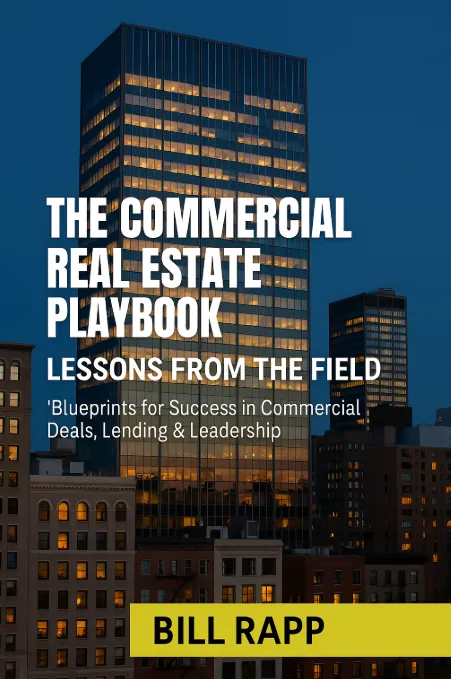
📘 Autographed Collector's Edition – Direct from the Author - CRE Book
What if your next commercial real estate deal could change your life—but no one ever taught you how to make it happen?
The Commercial Real Estate Playbook: Lessons From the Fieldis your behind-the-scenes guide to the strategies, mistakes, and mindset shifts that truly matter in today’s CRE world. Written by veteran broker and financing expert Bill Rapp, this book shares the real-world lessons he learned over a decade in the trenches—now available as an exclusive signed copy straight from the author.
Inside this special edition, you’ll discover:
✅ What separates winning deals from disasters
✅ How to confidently transition from residential to commercial real estate
✅ The psychology of reading people and closing with confidence
✅ Financing tips and creative capital strategies across all asset classes
✅ How to build a team, scale your business, and lead through uncertain times
Whether you're an investor, broker, small business owner, or just breaking into the commercial space, this no-fluff guide delivers the real talk—and real tools—you won’t find in a classroom.
Start building your CRE legacy with insights that actually work—and get your hands on a personally autographed copy today.
🏡 Autographed Collector's Edition – Direct from the Author - Residential Book
Buying your first home doesn’t have to be overwhelming—especially when you have a proven, step-by-step roadmap signed by the expert himself.
The Smart Guide to Buying Your First Home
is your friendly, no-nonsense companion through every stage of the homebuying process. Written by trusted
mortgage broker and real estate advisor Bill J. Rapp Jr.
, this autographed copy
offers not just practical advice, but peace of mind—straight from someone who’s helped hundreds of families navigate their first purchase.
Inside this signed special edition, you’ll
learn:
· 🧠 How credit scores
impact your loan—and how to fix yours fast
· 🏦What lenders really want to see and how to get pre-approved like a pro
· 💸Budgeting truths, hidden fees, and the myth of “$0 down”
· 🛠️The importance of building a dream team—agent, lender, and inspector
· 📝What to expect during inspections, appraisals, and closing, pl🇺🇸 Bonus content for VA borrowers, including how to get your COE and maximize your benefits
Every chapter includes clear action steps, checklists, and insider tips to help you stay organized, informed, and
empowered.
Whether you're buying solo, with a partner, or
for your growing family, this personally signed copy
is more than just a how-to guide—it’s your coach, mentor, and trusted friend for the journey ahead.
Order now to get a signed edition shipped directly from the author—and take the first confident step toward homeownership.

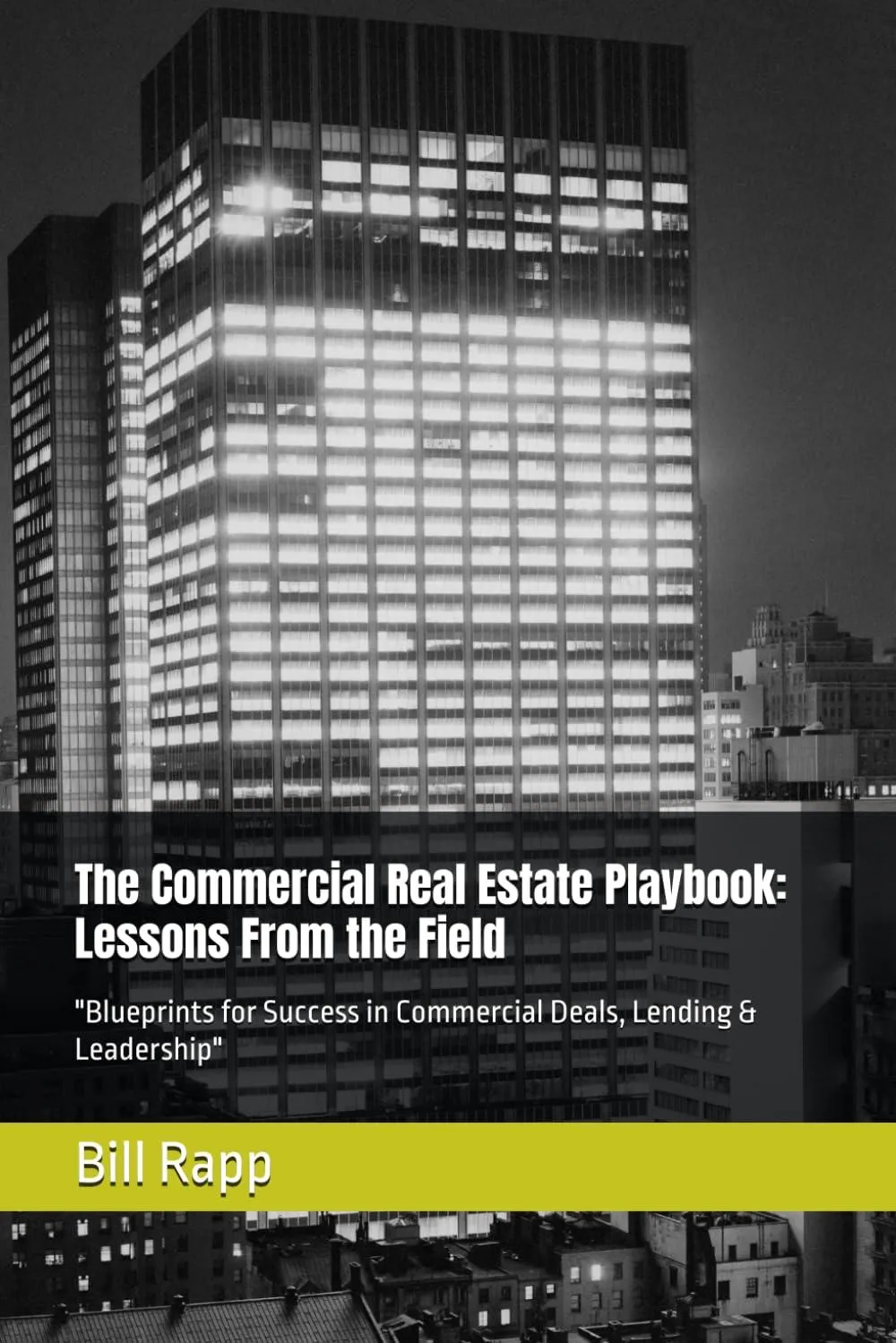
The Commercial Real Estate Playbook: Lessons From the Field:
"Blueprints for Success in Commercial Deals, Lending & Leadership"
What if your next commercial real estate deal could change your life—but no one ever taught you how to make it happen?
In
The Commercial Real Estate Playbook: Lessons From the Field, seasoned broker and finance expert
Bill Rapp
pulls back the curtain on the real-world strategies, pitfalls, and breakthrough moments that shaped his career—and the careers of countless clients and professionals he’s served.
From structuring your first deal and building your personal brand, to overcoming financing roadblocks and surviving market downturns, this no-fluff guide is packed with firsthand stories, actionable insights, and field-tested tools to help you thrive in today’s complex CRE landscape.
Whether you're an aspiring broker, active investor, small business owner, or someone looking to understand the lending side of real estate, this book offers a front-row seat to lessons that aren’t taught in classrooms—but can make or break your success.
Inside you’ll discover:
What separates successful deals from failed onesHow to transition from residential to commercial with confidenceThe art of reading people and closing like a proSmart financing tactics for every asset class—from retail to multifamilyHow to scale your business, lead a team, and future-proof your career
If you're ready to stop guessing and start building a legacy in commercial real estate, this playbook will be your trusted guide.
The Smart Guide to Buying Your First Home!
"From Credit Scores to Closing Day"
Buying your first home doesn’t have to be overwhelming — not when you have a proven roadmap in your hands.The Smart Guide to Buying Your First Home
is a friendly, practical, and down-to-earth companion for anyone ready to turn the dream of homeownership into a reality. Whether you're just starting to think about buying, already browsing listings, or preparing to make an offer, this guide breaks it all down — step-by-step — in language that makes sense.Written by seasoned mortgage broker and real estate advisor
Bill J Rapp Jr, this guide covers everything you need to know, including:
How your credit score affects your mortgage (and how to fix it fast)What lenders arereallylooking for — and how to get pre-approved like a proBudgeting tips, hidden costs, and why “$0 down” doesn’t mean “free”How to build your dream team and search with strategyThe real-deal guide to inspections, appraisals, and closing dayBonus insights forveterans using VA loans— including how to get your COE, debunking common VA myths, and planning for future moves or refinancing
Plus, you’ll find action steps, checklists, and practical tips in every chapter — making it easy to stay organized, empowered, and confident throughout the process.Whether you’re buying solo, with a partner, or as a growing family, this book will help you make smart decisions and avoid costly mistakes.
It’s more than a how-to manual — it’s a trusted guide, mentor, and coach all in one.Homeownership is a journey — not a race. Let’s take that first step together. 🏡


ABOUT AUTHOR
Bill Rapp
Bill Rapp is a seasoned commercial real estate broker and finance expert with over a decade of experience helping clients navigate complex property transactions and capital solutions. Based in Houston, Texas, Bill specializes in investment sales, acquisitions, and commercial financing strategies tailored to meet the needs of investors, developers, and business owners. He brings a
unique blend of market insight, negotiation skills, and financial acumen to every deal, consistently delivering value and growth opportunities for his clients. With a deep knowledge of the Houston and Greater Texas markets, Bill
is committed to building long-term relationships and helping clients make smart, strategic decisions in today’s ever-evolving real estate landscape. When
he’s not closing deals or analyzing the next big opportunity, Bill enjoys time with family, outdoor adventures, and giving back to the local community through mentorship and service.If you’d like, I can help write or edit these based on
the book content we’ve built so far.
- FOLLOW ON SOCIAL -


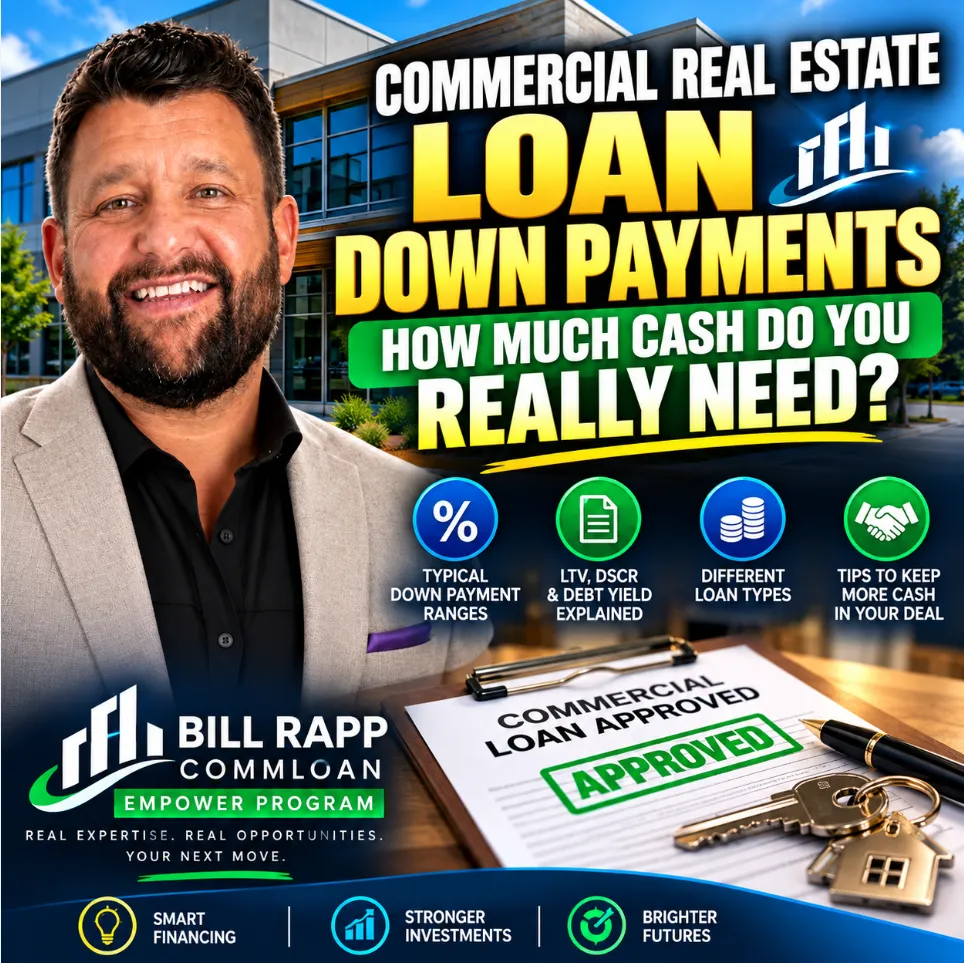
💰 Commercial Real Estate Loan Down Payments: How Much Cash Do You Really Need? 🏢
💰 Commercial Real Estate Loan Down Payments: How Much Cash Do You Really Need? 🏢
🏦 How Much Money Down Do You Need for a Commercial Real Estate Loan? A CRE Financing Guide 💵
________________________________________________________________________________
Commercial Real Estate Loan Down Payments: How Much Cash Do You Really Need?
When buying commercial real estate, one of the first questions investors and business owners ask is:
How much money do I need to put down?
The answer is rarely as simple as 20%, 25%, or 30%.
Unlike many residential mortgages, commercial real estate loans are typically structured around several variables, including the property's cash flow, loan-to-value ratio, debt service coverage ratio, property type, borrower strength, loan program, and lender requirements.
That means two buyers purchasing similar $2 million buildings could potentially need very different amounts of cash at closing.
Understanding these variables before making an offer can help you structure the transaction more effectively and avoid an unpleasant financing surprise later.
What Is a Typical Commercial Real Estate Loan Down Payment?
For many conventional commercial real estate loans, borrowers should generally be prepared for an equity contribution somewhere around 20% to 35% of the transaction, although actual requirements can fall outside that range.
For example, on a $2 million property:
·20% equity = $400,000
·25% equity = $500,000
·30% equity = $600,000
·35% equity = $700,000
But purchase price alone does not determine your required cash.
A lender may advertise a maximum loan-to-value ratio, but that does not necessarily mean the property qualifies for the maximum leverage.
LTV: The Starting Point
Loan-to-value (LTV) compares the loan amount with the property's value.
For example, assume you are purchasing a commercial property for $2 million and the lender allows 75% LTV.
At first glance:
$2,000,000 × 75% = $1,500,000 loan
That leaves $500,000 of equity before accounting for closing costs and other expenses.
But 75% LTV is generally a maximum, not a promise.
The lender still needs to determine whether the property's income supports that $1.5 million loan.
That's where DSCR becomes important.
DSCR Can Increase the Cash You Need
Debt service coverage ratio (DSCR) measures the property's net operating income relative to its required debt payments.
The basic formula is:
DSCR = Net Operating Income ÷ Annual Debt Service
Suppose a lender requires a 1.25x DSCR. The property needs to generate $1.25 of qualifying net operating income for every $1.00 of annual debt service.
If the property's NOI does not support the maximum LTV loan, the lender may reduce the loan amount.
Your down payment then increases.
This is why investors should not assume that a property qualifying for 75% LTV automatically means they only need 25% down.
Debt Yield May Also Limit Leverage
Some commercial lenders also evaluate debt yield.
Debt yield compares the property's NOI directly with the proposed loan amount:
Debt Yield = NOI ÷ Loan Amount
Unlike DSCR, debt yield is not directly dependent on the loan's interest rate or amortization schedule.
It gives lenders another way to evaluate the relationship between property-level cash flow and the amount of debt being requested.
For many CRE transactions, the actual loan proceeds may ultimately be constrained by whichever underwriting metric produces the lowest acceptable loan amount.
That could be LTV, DSCR, debt yield, or another lender-specific requirement.
Owner-Occupied Properties Can Be Different
Business owners purchasing the building their company will occupy may have additional financing options.
Depending on borrower and transaction eligibility, SBA financing may allow a lower equity contribution than many conventional commercial real estate loans.
Programs such as SBA 7(a) and SBA 504 can be particularly relevant for qualified owner-users purchasing real estate for their operating businesses.
However, lower equity does not automatically mean a transaction is the better financial choice. Borrowers should evaluate total financing costs, fees, prepayment provisions, loan structure, cash-flow impact, and working-capital requirements.
Investment Properties Are Primarily About Cash Flow
When financing investment commercial real estate, lenders typically focus heavily on the property's economics.
That includes factors such as:
Net Operating Income: Does the property generate enough sustainable income?
Occupancy: Is the property stabilized or still leasing up?
Tenant Quality: Who is responsible for paying the rent?
Lease Expirations: Are major tenants approaching rollover?
Market Rents: Are current rents sustainable relative to the market?
Property Type: Multifamily, retail, industrial, office, self-storage, and other asset classes can receive different underwriting treatment.
Sponsor Strength: Experience, liquidity, net worth, credit profile, and post-closing reserves can all matter.
A property with strong occupancy, durable cash flow, diversified tenants, and an experienced sponsor may present a very different financing profile from a transitional property with substantial vacancy.
Your Down Payment Isn't Your Only Cash Requirement
One of the biggest mistakes commercial real estate buyers can make is focusing exclusively on the down payment.
Your total cash requirement may also include:
·Closing costs and lender fees
·Third-party reports
·Appraisal
·Environmental assessments
·Property condition reports
·Legal expenses
·Title and survey expenses
·Insurance and tax escrows
·Required reserves
·Immediate repairs or renovations
·Tenant improvements and leasing costs
·Working capital
That distinction matters.
If you have $500,000 available and use virtually all of it for the equity contribution, what happens when the lender requires additional reserves or the building needs $75,000 of improvements immediately after closing?
The goal should not simply be to get the deal closed. The capital structure should also make sense after closing.
A $2 Million Example
Consider an investor purchasing a commercial property for $2 million.
At 75% LTV, the theoretical loan is $1.5 million, requiring $500,000 of equity.
But suppose the property's NOI only supports a $1.35 million loan under the lender's DSCR requirement.
Now the buyer needs approximately:
$2,000,000 – $1,350,000 = $650,000
That's a 32.5% equity contribution, even though the lender may technically offer financing up to 75% LTV.
And the buyer may still need additional cash for closing costs, reserves, improvements, or other transaction expenses.
That's why commercial financing should ideally be analyzed before you become deeply committed to the acquisition.
Can You Reduce the Amount of Cash You Need?
Potentially.
The answer depends on the property, borrower, transaction, and available loan programs.
Possible strategies can include evaluating different lender categories, SBA financing for qualified owner-users, seller financing, subordinate financing where permitted, structured equity, or negotiating transaction terms that reduce other cash requirements.
The key is to evaluate the entire capital stack, rather than focusing solely on the interest rate.
A loan with a slightly lower rate but substantially lower proceeds could require far more equity than another financing structure.
For an investor or business owner trying to preserve liquidity, proceeds can be just as important as pricing.
Why Shopping the Capital Markets Matters
Commercial lenders do not all underwrite transactions the same way.
Banks, credit unions, agency lenders, debt funds, bridge lenders, SBA lenders, insurance companies, and other capital sources can have different appetites and underwriting requirements.
One lender may be uncomfortable with the property type.
Another may dislike the geographic market.
Another may be constrained by DSCR.
And another may structure the transaction differently.
Through the CommLoan Empower Program, I help commercial real estate investors and business owners evaluate financing opportunities across a broad lender marketplace and identify structures that align with the transaction and the borrower's objectives.
Know Your Cash Requirement Before You Make the Offer
Before submitting an LOI or signing a purchase agreement, ask more than:
“What is the maximum LTV?”
Instead, determine:
What loan amount does the property's cash flow actually support?
Then calculate your equity contribution, closing expenses, reserves, improvements, and post-closing liquidity.
That's a much more useful estimate of how much cash you really need.
A strong commercial real estate financing strategy isn't simply about finding the lowest rate.
It's about building a capital structure that works for the property, the borrower, and the long-term investment strategy.
Bill Rapp, CCIM
CommLoan Empower Program
Commercial real estate financing for investors and business owners.
Top of Form
Bottom of Form
Bill Rapp, CCIM
Director | CommLoan
📞 281-222-0433
📧 [email protected]
🌐 https://billrapp.commloan.com/
🌐 https://HoustonCommercialMortgage.com/
Commercial Real Estate Financing Nationwide
https://billrapp.commloan.com/
https://author.billrapponline.com/
https://www.amazon.com/dp/B0F32Z5BH2
https://veed.cello.so/FOmzTty6oi9
https://buymeacoffee.com/vikingente3
https://creplaybookseries.billrapponline.com
https://creplaybook.billrapponline.com/
©Bill Rapp, CCIM - Director - CommLoan

Subscribe to Our Newsletter
New Released


Historical Romance
Whispers of the Heart
A young woman stumbles upon a hidden love letter from the past, leading her on a journey to uncover a long-forgotten romance that changed her family forever.
Over A Million Copies Sold!
Stats
Your Perfect Read, Our Promise
Discover the difference our books make through key statistics. From captivating plots to satisfied readers, our numbers showcase the quality, creativity, and trust that define our literary works.
1M+
Satisfied Readers

100+
Books Published
50+
Genres Explored
- LATEST BOOKS -
All Latest Books

Pumpkin Patch Murder
A farm owner investigates a murder at the pumpkin patch just before Halloween, racing to solve the crime before the season is ruined.

Tea and Crime
A café owner investigates a murder after one of her loyal customers is found dead in her shop.

Antique Secrets
An antique store owner uncovers a hidden diary and is drawn into a decades-old mystery.
OUR WORK
What People Are Saying!

"I was hooked from the first page! This author’s storytelling is captivating, and the plot twists kept me on the edge of my seat. Can't wait for the next book!"

Sarah Thompson
"An incredible read! The characters felt so real, and the pacing was perfect. I couldn't put it down. Highly recommend to any mystery lover!"
Lia Johnson
"This author never disappoints! The writing is gripping, the plot unpredictable, and the suspense builds perfectly. Another fantastic book!"

Ethan Clark
- OUR BLOG POST -
Latest News & Article
Januuary 12, 2024
Mastering the Art of Character Development: Tips for Writing Compelling Protagonists

April 11, 2023
Cover Design 101: Tips for Creating an Eye-Catching...
June 25, 2023
Plotting 101: How to Create a Gripping Story Arc from Start to Finish
Dec 16, 2023
The Power of Dialogue: How to Write Conversations that Drive Your Story Forward
Frequently Asked Questions
What types of books do you write?
We specialize in a wide range of genres including historical fiction, romance, mystery, fantasy, and more. Our goal is to create stories that captivate and engage readers from all walks of life.
Where can I purchase your books?
Our books are available on major platforms like Amazon, Barnes & Noble, and local bookstores. You can also find them in e-book and audiobook formats for easy access.
Do you offer signed copies of your books?
Subscribe to our newsletter for the latest updates, book releases, and exclusive offers. Follow us on social media to stay connected and receive real-time news.
How can I stay updated on your new releases?
Subscribe to our newsletter for the latest updates, book releases, and exclusive offers. Follow us on social media to stay connected and receive real-time news.
Do you accept book reviews from readers?
Absolutely! We encourage our readers to leave reviews on platforms like Goodreads, Amazon, or personal blogs. Your feedback helps us grow and reach new audiences.
Can I request a book to be personalized?
Yes, we offer personalized book services. Please contact us directly for more information on how we can make your book special.
Drain Repair And Maintenance
You can contact us through our website’s contact page, or by emailing us directly. We love hearing from readers and potential collaborators!
Do you have a fan club or book club?
We have an active community of fans! Join our book club or fan group online to discuss books, share recommendations, and enjoy exclusive content from our latest releases.

COMPANY
LEGAL
FOLLOW US

©Copyright 2026.. All Rights Reserved.