📘 Autographed Collector's Edition – Direct from the Author - CRE Book
What if your next commercial real estate deal could change your life—but no one ever taught you how to make it happen?
The Commercial Real Estate Playbook: Lessons From the Fieldis your behind-the-scenes guide to the strategies, mistakes, and mindset shifts that truly matter in today’s CRE world. Written by veteran broker and financing expert Bill Rapp, this book shares the real-world lessons he learned over a decade in the trenches—now available as an exclusive signed copy straight from the author.
Inside this special edition, you’ll discover:
✅ What separates winning deals from disasters
✅ How to confidently transition from residential to commercial real estate
✅ The psychology of reading people and closing with confidence
✅ Financing tips and creative capital strategies across all asset classes
✅ How to build a team, scale your business, and lead through uncertain times
Whether you're an investor, broker, small business owner, or just breaking into the commercial space, this no-fluff guide delivers the real talk—and real tools—you won’t find in a classroom.
Start building your CRE legacy with insights that actually work—and get your hands on a personally autographed copy today.
🏡 Autographed Collector's Edition – Direct from the Author - Residential Book
Buying your first home doesn’t have to be overwhelming—especially when you have a proven, step-by-step roadmap signed by the expert himself.
The Smart Guide to Buying Your First Home
is your friendly, no-nonsense companion through every stage of the homebuying process. Written by trusted
mortgage broker and real estate advisor Bill J. Rapp Jr.
, this autographed copy
offers not just practical advice, but peace of mind—straight from someone who’s helped hundreds of families navigate their first purchase.
Inside this signed special edition, you’ll
learn:
· 🧠 How credit scores
impact your loan—and how to fix yours fast
· 🏦What lenders really want to see and how to get pre-approved like a pro
· 💸Budgeting truths, hidden fees, and the myth of “$0 down”
· 🛠️The importance of building a dream team—agent, lender, and inspector
· 📝What to expect during inspections, appraisals, and closing, pl🇺🇸 Bonus content for VA borrowers, including how to get your COE and maximize your benefits
Every chapter includes clear action steps, checklists, and insider tips to help you stay organized, informed, and
empowered.
Whether you're buying solo, with a partner, or
for your growing family, this personally signed copy
is more than just a how-to guide—it’s your coach, mentor, and trusted friend for the journey ahead.
Order now to get a signed edition shipped directly from the author—and take the first confident step toward homeownership.

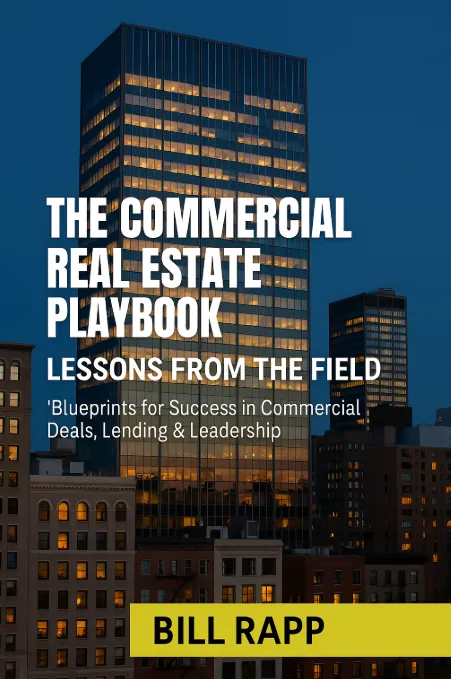
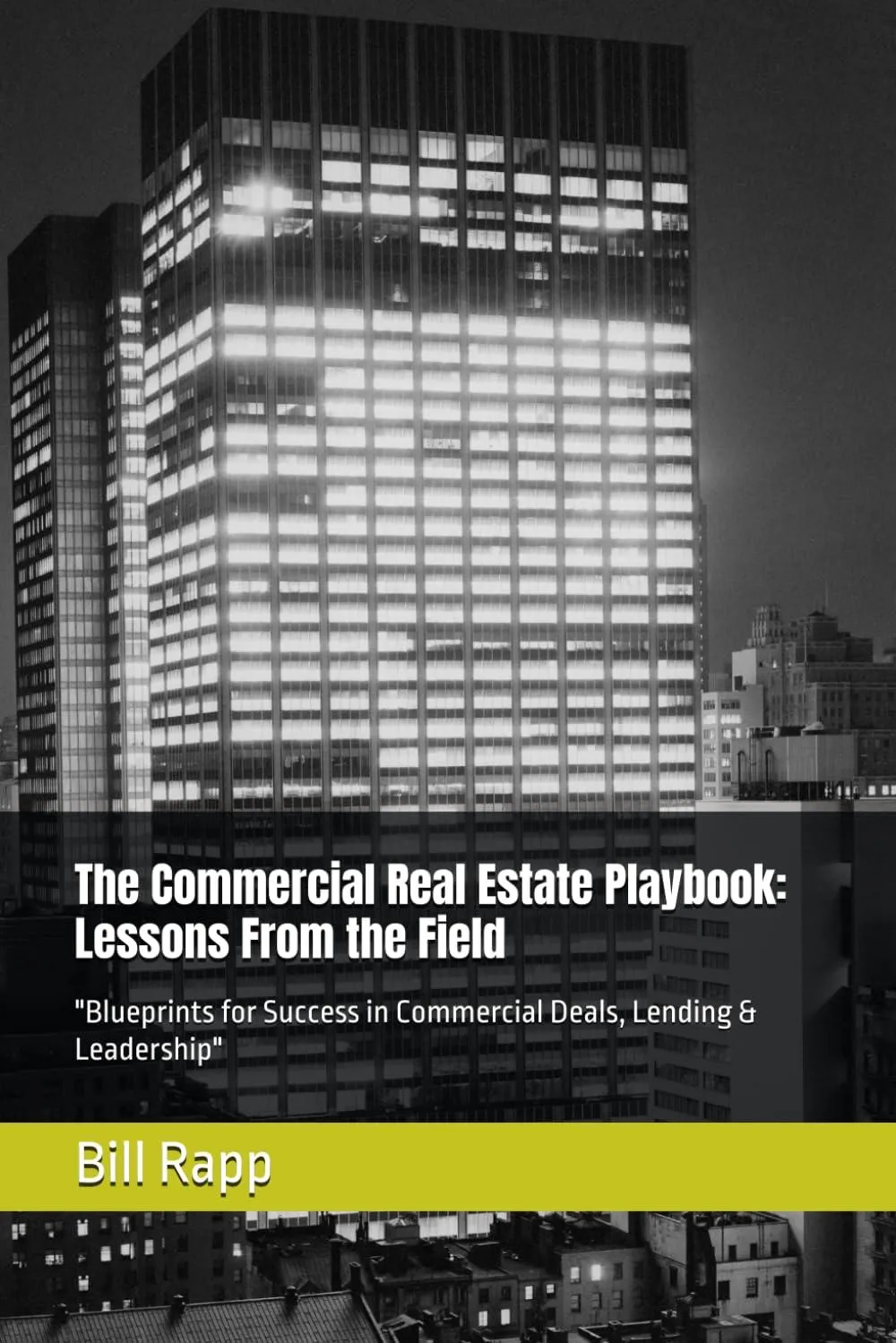
The Commercial Real Estate Playbook: Lessons From the Field:
"Blueprints for Success in Commercial Deals, Lending & Leadership"
What if your next commercial real estate deal could change your life—but no one ever taught you how to make it happen?
In
The Commercial Real Estate Playbook: Lessons From the Field, seasoned broker and finance expert
Bill Rapp
pulls back the curtain on the real-world strategies, pitfalls, and breakthrough moments that shaped his career—and the careers of countless clients and professionals he’s served.
From structuring your first deal and building your personal brand, to overcoming financing roadblocks and surviving market downturns, this no-fluff guide is packed with firsthand stories, actionable insights, and field-tested tools to help you thrive in today’s complex CRE landscape.
Whether you're an aspiring broker, active investor, small business owner, or someone looking to understand the lending side of real estate, this book offers a front-row seat to lessons that aren’t taught in classrooms—but can make or break your success.
Inside you’ll discover:
What separates successful deals from failed onesHow to transition from residential to commercial with confidenceThe art of reading people and closing like a proSmart financing tactics for every asset class—from retail to multifamilyHow to scale your business, lead a team, and future-proof your career
If you're ready to stop guessing and start building a legacy in commercial real estate, this playbook will be your trusted guide.
The Smart Guide to Buying Your First Home!
"From Credit Scores to Closing Day"
Buying your first home doesn’t have to be overwhelming — not when you have a proven roadmap in your hands.The Smart Guide to Buying Your First Home
is a friendly, practical, and down-to-earth companion for anyone ready to turn the dream of homeownership into a reality. Whether you're just starting to think about buying, already browsing listings, or preparing to make an offer, this guide breaks it all down — step-by-step — in language that makes sense.Written by seasoned mortgage broker and real estate advisor
Bill J Rapp Jr, this guide covers everything you need to know, including:
How your credit score affects your mortgage (and how to fix it fast)What lenders arereallylooking for — and how to get pre-approved like a proBudgeting tips, hidden costs, and why “$0 down” doesn’t mean “free”How to build your dream team and search with strategyThe real-deal guide to inspections, appraisals, and closing dayBonus insights forveterans using VA loans— including how to get your COE, debunking common VA myths, and planning for future moves or refinancing
Plus, you’ll find action steps, checklists, and practical tips in every chapter — making it easy to stay organized, empowered, and confident throughout the process.Whether you’re buying solo, with a partner, or as a growing family, this book will help you make smart decisions and avoid costly mistakes.
It’s more than a how-to manual — it’s a trusted guide, mentor, and coach all in one.Homeownership is a journey — not a race. Let’s take that first step together. 🏡


ABOUT AUTHOR
Bill Rapp
Bill Rapp is a seasoned commercial real estate broker and finance expert with over a decade of experience helping clients navigate complex property transactions and capital solutions. Based in Houston, Texas, Bill specializes in investment sales, acquisitions, and commercial financing strategies tailored to meet the needs of investors, developers, and business owners. He brings a
unique blend of market insight, negotiation skills, and financial acumen to every deal, consistently delivering value and growth opportunities for his clients. With a deep knowledge of the Houston and Greater Texas markets, Bill
is committed to building long-term relationships and helping clients make smart, strategic decisions in today’s ever-evolving real estate landscape. When
he’s not closing deals or analyzing the next big opportunity, Bill enjoys time with family, outdoor adventures, and giving back to the local community through mentorship and service.If you’d like, I can help write or edit these based on
the book content we’ve built so far.
- FOLLOW ON SOCIAL -


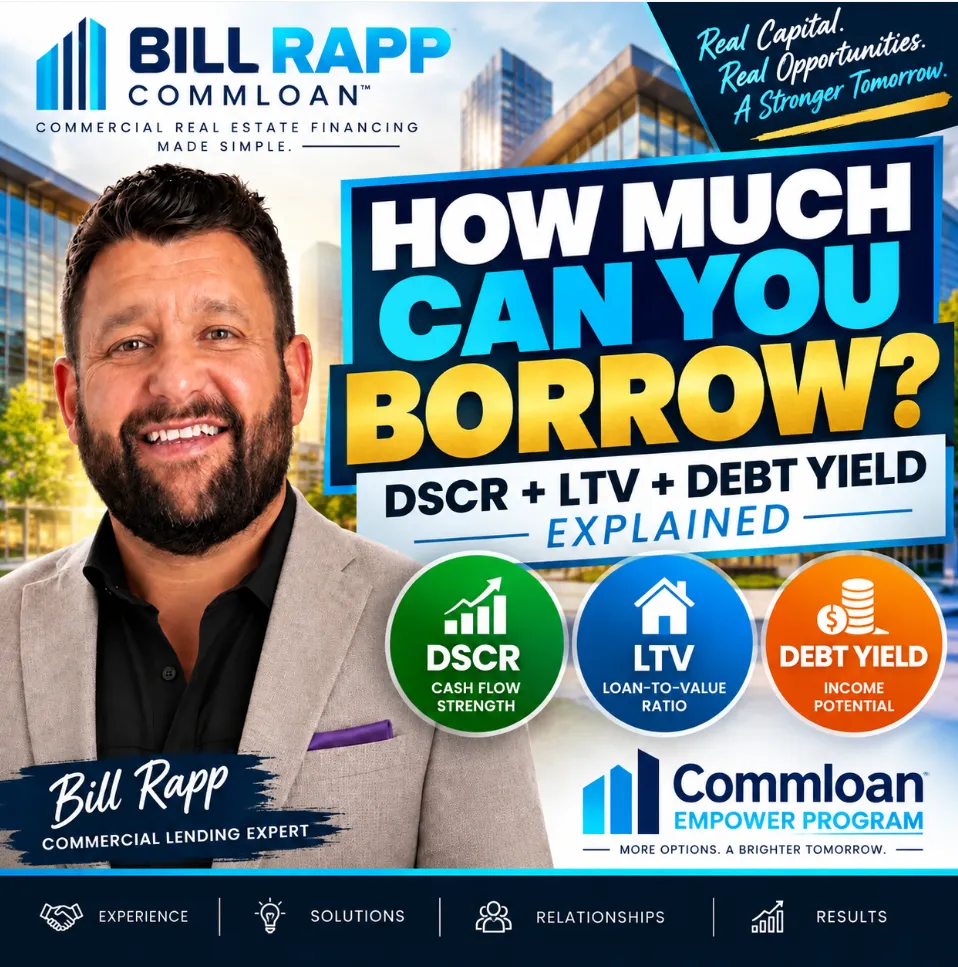
🏢 How Much Can You Borrow on Commercial Real Estate? DSCR, LTV & Debt Yield Explained 💰
🏢 How Much Can You Borrow on Commercial Real Estate? DSCR, LTV & Debt Yield Explained 💰
📊 Commercial Real Estate Loan Sizing: How DSCR, LTV & Debt Yield Determine Your Maximum Loan 🏦
How Much Can You Borrow? DSCR + LTV + Debt Yield Explained
How Much Can You Borrow? DSCR + LTV + Debt Yield Explained
When commercial real estate investors ask, “How much can I borrow?”, there usually isn't one simple answer.
Unlike many residential mortgages, where borrower income and debt-to-income ratios play a major role, commercial real estate lenders often focus heavily on the economics of the property itself.
Three calculations frequently determine how much financing a commercial property can support:
DSCR — Debt Service Coverage Ratio
LTV — Loan-to-Value Ratio
Debt Yield
Understanding these three commercial real estate lending metrics can help you estimate loan proceeds before approaching a lender—and understand why the loan amount a lender offers may be lower than you expected.
What Determines How Much You Can Borrow on Commercial Real Estate?
Commercial lenders typically evaluate several factors, including:
·Property net operating income
·Property value
·Requested loan amount
·Annual debt service
·Interest rate
·Amortization period
·Property type
·Occupancy and tenant quality
·Lease rollover
·Borrower liquidity and net worth
·Sponsor experience
·Market conditions
But DSCR, LTV and debt yield are three of the most important measurements used to size many commercial real estate loans.
The important point is this:
The maximum loan isn't necessarily determined by the metric that looks best. It can be determined by whichever underwriting constraint produces the lowest acceptable loan amount.
Let's examine each one.
1. What Is DSCR?
Debt Service Coverage Ratio (DSCR) measures a property's ability to generate enough net operating income to cover its required loan payments.
The basic formula is:
DSCR = Net Operating Income ÷ Annual Debt Service
Suppose an investment property produces $150,000 of annual NOI and the proposed mortgage requires $120,000 of annual principal and interest payments.
The DSCR would be:
$150,000 ÷ $120,000 = 1.25x DSCR
A 1.25x DSCR means the property generates $1.25 of NOI for every $1.00 of annual debt service.
Why DSCR Matters
Lenders want a cushion between property income and required debt payments.
A property operating at exactly 1.00x DSCR would theoretically generate only enough NOI to make its debt payments, leaving no underwriting cushion if revenue declines or expenses increase.
Required DSCR varies by lender, property type, transaction and market conditions.
That's why borrowers should never assume that one DSCR requirement applies to every commercial loan.
How Interest Rates Affect DSCR Loan Proceeds
DSCR also explains why rising interest rates can reduce borrowing capacity even when a property's NOI hasn't changed.
Consider a property generating the same $150,000 NOI.
If a lender requires a 1.25x DSCR, maximum annual debt service would be:
$150,000 ÷ 1.25 = $120,000
The loan amount supported by that $120,000 payment depends on the interest rate and amortization schedule.
Higher rates generally mean the same annual debt-service allowance supports less principal.
This is one reason commercial real estate investors can encounter a refinancing gap at maturity.
The property's income may still be healthy, but today's interest rate may not support the outstanding loan balance under the lender's DSCR requirement.
2. What Is LTV?
Loan-to-Value Ratio (LTV) compares the loan amount with the lender's accepted property value.
The formula is:
LTV = Loan Amount ÷ Property Value
For example, assume a property is valued at $2,000,000 and the requested loan is $1,400,000.
The LTV is:
$1,400,000 ÷ $2,000,000 = 70% LTV
From another perspective, if a lender permits a maximum 70% LTV on a $2 million property, the leverage-based maximum would be:
$2,000,000 × 70% = $1,400,000
Simple enough—but there is an important catch.
LTV Does Not Guarantee the Loan Amount
Borrowers sometimes make the mistake of assuming:
“The lender offers 75% LTV, so I can borrow 75% of the property's value.”
Not necessarily.
The loan still has to satisfy the lender's other underwriting requirements.
Imagine a $2 million property with a 75% maximum LTV.
That would theoretically allow:
$2,000,000 × 75% = $1,500,000
But what if the property's NOI only supports a $1.25 million loan under the lender's DSCR requirement?
The borrower may be limited to approximately $1.25 million despite the higher LTV threshold.
Maximum LTV is a ceiling—not a promise of proceeds.
3. What Is Debt Yield?
Debt yield measures the property's NOI relative to the loan amount.
The formula is:
Debt Yield = NOI ÷ Loan Amount
Suppose a property generates $150,000 of NOI and the requested commercial mortgage is $1,500,000.
Debt yield would be:
$150,000 ÷ $1,500,000 = 10%
Debt yield gives lenders another way to evaluate leverage and risk.
Unlike DSCR, debt yield is not directly dependent on the interest rate or amortization period.
That makes it useful as a relatively straightforward measure of how much property income exists relative to the lender's principal exposure.
Reverse the Debt Yield Formula to Estimate Loan Proceeds
Debt yield can also be used to estimate maximum loan proceeds.
Assume:
NOI = $150,000
Required Debt Yield = 10%
Then:
Maximum Loan = NOI ÷ Required Debt Yield
$150,000 ÷ 10% = $1,500,000
If the lender instead required a 12% debt yield:
$150,000 ÷ 12% = $1,250,000
Same property. Same NOI.
But the more conservative debt-yield requirement reduces potential proceeds by $250,000.
DSCR vs. LTV vs. Debt Yield: Which One Determines Your Loan Amount?
Potentially all three.
Consider this simplified example.
A commercial investor owns a property valued at $3 million with $210,000 in annual NOI.
After applying its underwriting requirements, suppose a lender determines:
LTV allows: $2,100,000
DSCR supports: $1,850,000
Debt yield supports: $1,750,000
Which loan amount matters?
The debt-yield constraint is the most restrictive in this simplified scenario.
That means a borrower expecting approximately $2.1 million based solely on LTV could be surprised when the lender's underwriting produces substantially lower proceeds.
This is why sophisticated commercial financing analysis should evaluate multiple constraints before a borrower starts negotiating a transaction.
Why NOI Is So Important
Notice that both DSCR and debt yield depend directly on Net Operating Income.
That makes accurate NOI underwriting critical.
Commercial lenders may examine:
·Historical operating statements
·Trailing-12-month financials
·Current rent rolls
·Existing leases
·Contractual rent
·Vacancy
·Concessions
·Property taxes
·Insurance
·Repairs and maintenance
·Management expenses
·Replacement reserves
·Nonrecurring income and expenses
The borrower's stated NOI and the lender's underwritten NOI aren't always identical.
A lender may adjust revenue or expenses when determining sustainable cash flow.
A seemingly small NOI adjustment can materially change borrowing capacity.
Why Commercial Loan Quotes Can Vary Between Lenders
Another important point for investors and business owners is that different lenders can analyze the same transaction differently.
A bank, credit union, CMBS lender, debt fund or other capital source may have different requirements for:
·Minimum DSCR
·Maximum LTV
·Minimum debt yield
·Amortization
·Recourse
·Liquidity
·Net worth
·Property type
·Occupancy
·Loan size
·Sponsor experience
·Geographic concentration
This means the question isn't simply:
“Can I get a commercial loan?”
A better question is:
“Which capital source provides the best combination of proceeds, pricing, structure and execution for this particular property and borrower?”
Owner-Occupied Commercial Real Estate Can Be Different
DSCR, LTV and debt yield are especially important concepts in investment-property lending, but owner-occupied commercial real estate can be underwritten differently.
For an owner-user property, the lender may place greater emphasis on the operating company's cash flow and global debt-service ability in addition to collateral value.
SBA financing can introduce another set of eligibility and underwriting considerations.
The correct financing analysis therefore depends on both the property and the transaction structure.
How to Estimate Your Commercial Real Estate Borrowing Capacity
Before requesting financing, assemble the information needed to perform an initial loan-sizing analysis.
At minimum, an investor should know:
1.Current or projected NOI
2.Estimated property value or purchase price
3.Existing debt balance, if refinancing
4.Requested loan amount
5.Property type
6.Occupancy
7.Major lease expirations
8.Borrower liquidity and net worth
9.Desired loan term
10.Purpose of the financing
From there, you can evaluate the transaction through multiple underwriting lenses instead of relying solely on a target LTV.
The Bottom Line
When asking how much you can borrow on commercial real estate, don't look at LTV alone.
Think in terms of three underwriting tests:
DSCR asks: Does the property generate enough cash flow to service the debt?
LTV asks: How much leverage is being placed against the property's value?
Debt yield asks: How much NOI does the lender receive relative to its loan exposure?
The interaction among these metrics helps determine how much debt a property can realistically support.
And because lenders have different credit policies, a deal that doesn't fit one lender's parameters may fit another lender's structure differently.
Need Help Evaluating a Commercial Real Estate Loan?
Before approaching the market, it can be useful to determine how your transaction looks from a lender's perspective.
I work with commercial real estate investors and business owners to evaluate financing scenarios, analyze potential loan proceeds and compare capital sources.
Bill Rapp | CommLoan Empower Program
Commercial real estate financing should begin with the numbers—not with a guess about how much a lender will provide.
Top of Form
Bottom of Form
Bill Rapp, CCIM
Director | CommLoan
📞 281-222-0433
📧 [email protected]
🌐 https://billrapp.commloan.com/
🌐 https://HoustonCommercialMortgage.com/
Commercial Real Estate Financing Nationwide
https://billrapp.commloan.com/
https://author.billrapponline.com/
https://www.amazon.com/dp/B0F32Z5BH2
https://veed.cello.so/FOmzTty6oi9
https://buymeacoffee.com/vikingente3
https://creplaybookseries.billrapponline.com
https://creplaybook.billrapponline.com/
©Bill Rapp, CCIM - Director - CommLoan

Subscribe to Our Newsletter
New Released


Historical Romance
Whispers of the Heart
A young woman stumbles upon a hidden love letter from the past, leading her on a journey to uncover a long-forgotten romance that changed her family forever.
Over A Million Copies Sold!
Stats
Your Perfect Read, Our Promise
Discover the difference our books make through key statistics. From captivating plots to satisfied readers, our numbers showcase the quality, creativity, and trust that define our literary works.
1M+
Satisfied Readers

100+
Books Published
50+
Genres Explored
- LATEST BOOKS -
All Latest Books

Pumpkin Patch Murder
A farm owner investigates a murder at the pumpkin patch just before Halloween, racing to solve the crime before the season is ruined.

Tea and Crime
A café owner investigates a murder after one of her loyal customers is found dead in her shop.

Antique Secrets
An antique store owner uncovers a hidden diary and is drawn into a decades-old mystery.
OUR WORK
What People Are Saying!

"I was hooked from the first page! This author’s storytelling is captivating, and the plot twists kept me on the edge of my seat. Can't wait for the next book!"

Sarah Thompson
"An incredible read! The characters felt so real, and the pacing was perfect. I couldn't put it down. Highly recommend to any mystery lover!"
Lia Johnson
"This author never disappoints! The writing is gripping, the plot unpredictable, and the suspense builds perfectly. Another fantastic book!"

Ethan Clark
- OUR BLOG POST -
Latest News & Article

Januuary 12, 2024
Mastering the Art of Character Development: Tips for Writing Compelling Protagonists

April 11, 2023
Cover Design 101: Tips for Creating an Eye-Catching...
June 25, 2023
Plotting 101: How to Create a Gripping Story Arc from Start to Finish
Dec 16, 2023
The Power of Dialogue: How to Write Conversations that Drive Your Story Forward
Frequently Asked Questions
What types of books do you write?
We specialize in a wide range of genres including historical fiction, romance, mystery, fantasy, and more. Our goal is to create stories that captivate and engage readers from all walks of life.
Where can I purchase your books?
Our books are available on major platforms like Amazon, Barnes & Noble, and local bookstores. You can also find them in e-book and audiobook formats for easy access.
Do you offer signed copies of your books?
Subscribe to our newsletter for the latest updates, book releases, and exclusive offers. Follow us on social media to stay connected and receive real-time news.
How can I stay updated on your new releases?
Subscribe to our newsletter for the latest updates, book releases, and exclusive offers. Follow us on social media to stay connected and receive real-time news.
Do you accept book reviews from readers?
Absolutely! We encourage our readers to leave reviews on platforms like Goodreads, Amazon, or personal blogs. Your feedback helps us grow and reach new audiences.
Can I request a book to be personalized?
Yes, we offer personalized book services. Please contact us directly for more information on how we can make your book special.
Drain Repair And Maintenance
You can contact us through our website’s contact page, or by emailing us directly. We love hearing from readers and potential collaborators!
Do you have a fan club or book club?
We have an active community of fans! Join our book club or fan group online to discuss books, share recommendations, and enjoy exclusive content from our latest releases.

COMPANY
LEGAL
FOLLOW US

©Copyright 2026.. All Rights Reserved.